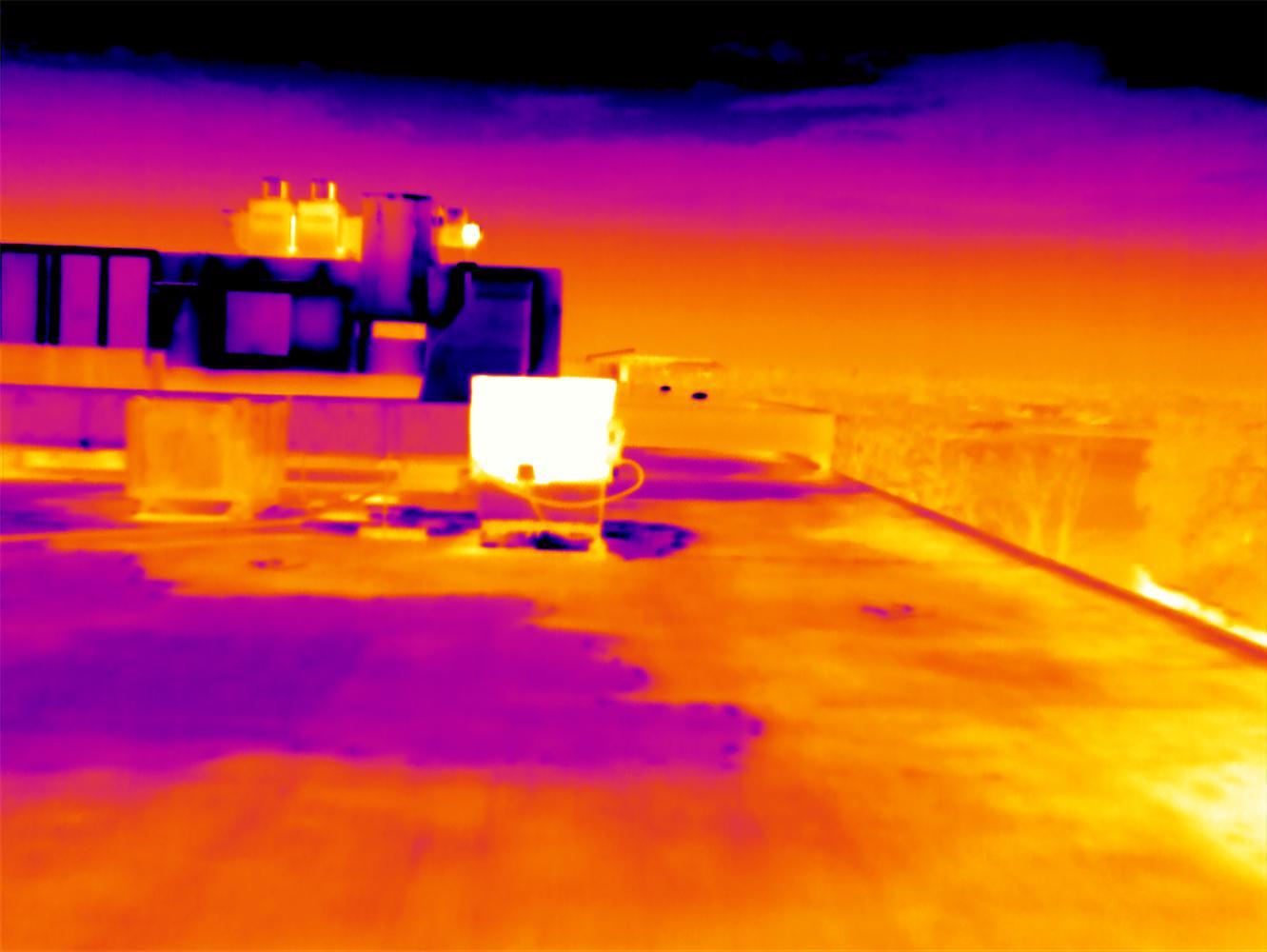
Infrared thermographic surveys locate wet insulation in Memphis commercial flat roofs without tearing the membrane - critical data before any replacement or recover decision, and the only honest basis for a replace-versus-recover recommendation.
The recover-versus-replace decision on a Memphis commercial roof ultimately comes down to insulation moisture content. If the insulation is dry, a recover with a new single-ply membrane is a legitimate capital option - often delivering 15-20 years of additional service life at roughly half the cost of full replacement. If the insulation is wet, a recover traps the moisture underneath the new membrane, voids the new warranty within the first inspection cycle, and produces the same failure pattern again in three to five years. The only defensible way to make this call is with moisture data.
Infrared thermographic scanning is the non-destructive method for mapping wet insulation across an entire commercial roof. It works on a straightforward physical principle: wet insulation retains heat longer than dry insulation after sunset. When the roof surface cools as evening temperatures drop, wet insulation areas cool more slowly than dry areas - this differential shows up on an infrared camera as warm zones against a cooling background. An experienced operator walking the roof with a calibrated infrared camera after sunset maps wet areas precisely, down to within a foot or two of the actual moisture boundary.
How Infrared Scanning Works on a Memphis Commercial Roof
Timing requirements: Effective infrared moisture scanning requires a minimum four-to-six hour thermal differential between daytime solar gain and nighttime cooling. In Memphis, the optimal scanning window runs from approximately 90 minutes after sunset until the roof surface reaches ambient temperature equilibrium - typically a two to three hour window. We schedule scans on clear evenings after full sun days, which is why scan work is scheduled 24-48 hours in advance based on Memphis weather forecast.
Camera calibration and protocol: We use calibrated infrared cameras with thermal sensitivity of 0.05°C or better. The camera is calibrated against ambient temperature before every scan, and the operator maintains a consistent scan distance and angle across the full roof surface. We do not walk random sample areas - we walk systematic parallel passes covering every section of the roof. Survey coverage maps are documented so the client can see that the entire roof surface was scanned.
Core pull verification: Infrared identifies suspected wet zones; core pulls verify them. After the infrared scan we map the warm-zone pattern on the roof plan, then pull moisture cores in five to ten locations across the scan pattern - both in identified wet zones and in adjacent dry zones - to calibrate the scan result against physical samples. This dual method produces wet-zone boundaries accurate enough to use as the basis for selective insulation replacement in a recover project.
What Infrared Scanning Produces for Your Decision
Wet-zone map: A scaled roof plan with all infrared-identified wet zones shaded and labeled with percentage of total roof area. This is the core deliverable - it tells you, precisely, what percentage of your insulation is saturated. Our replacement recommendation threshold is 25%: below 25% wet, a targeted-remove recover is typically the better capital call; above 25%, full replacement becomes the economical option because selective insulation removal in a recover scope becomes too disruptive to justify the cost savings.
Recover scope data: If the scan recommends recover, the wet-zone map becomes the selective insulation replacement drawing - the crews use it to identify exactly which insulation sections to remove before laying the new membrane. This precision avoids both over-removal (pulling good insulation unnecessarily) and under-removal (leaving wet sections that void the new warranty). Memphis building owners who have used this process on their aging commercial portfolio report significant capital savings versus full replacement cycles.
Insurance documentation: Post-storm infrared surveys document moisture infiltration that is not yet visible at the ceiling - water that has entered through storm-damaged flashings or membrane punctures but has not traveled to interior surfaces. Insurance adjusters accept infrared survey results as primary evidence of storm-related moisture damage when the scan is conducted within a reasonable time after the storm event and is correlated with visible storm-damage indicators.
Memphis Buildings That Benefit Most from Infrared Scanning
Aerotropolis distribution and cold-storage facilities: The cargo and logistics buildings surrounding Memphis International Airport - many of them 150,000 to 600,000 square feet of single-story industrial built in the 2000s FedEx expansion period - are now 15-25 years old and entering first major reroof cycles. The capital cost difference between a recover and a full replacement on a 300,000 sq ft facility is substantial. An infrared survey that definitively maps wet insulation zones converts a contractor's opinion into defensible data for the ownership group's capital committee.
Medical District buildings along Madison Avenue: The occupied clinical and research facilities in the Memphis Medical District cannot afford an inaccurate replace-versus-recover recommendation. A full tear-off on an occupied research floor requires extensive interior protection, infection control coordination, and operational disruption that a recover avoids entirely. Getting the wet-insulation answer right before the scope decision is worth significantly more than the cost of the infrared survey.
Downtown and Midtown historic warehouse conversions: The adaptive reuse warehouse inventory in South Main, Downtown, and Midtown contains aging roof systems - some with multiple recover layers accumulated over decades. Infrared scanning on these buildings frequently reveals moisture patterns that have been accumulating for years, documenting the full extent of the problem before an ownership group commits to a renovation scope.
Get infrared moisture scan data before your next roof decision.
We schedule Memphis infrared surveys based on a 48-hour weather window - clear skies, no recent rain. Walk the full roof surface, map the wet zones, and give you data that supports a real capital decision.