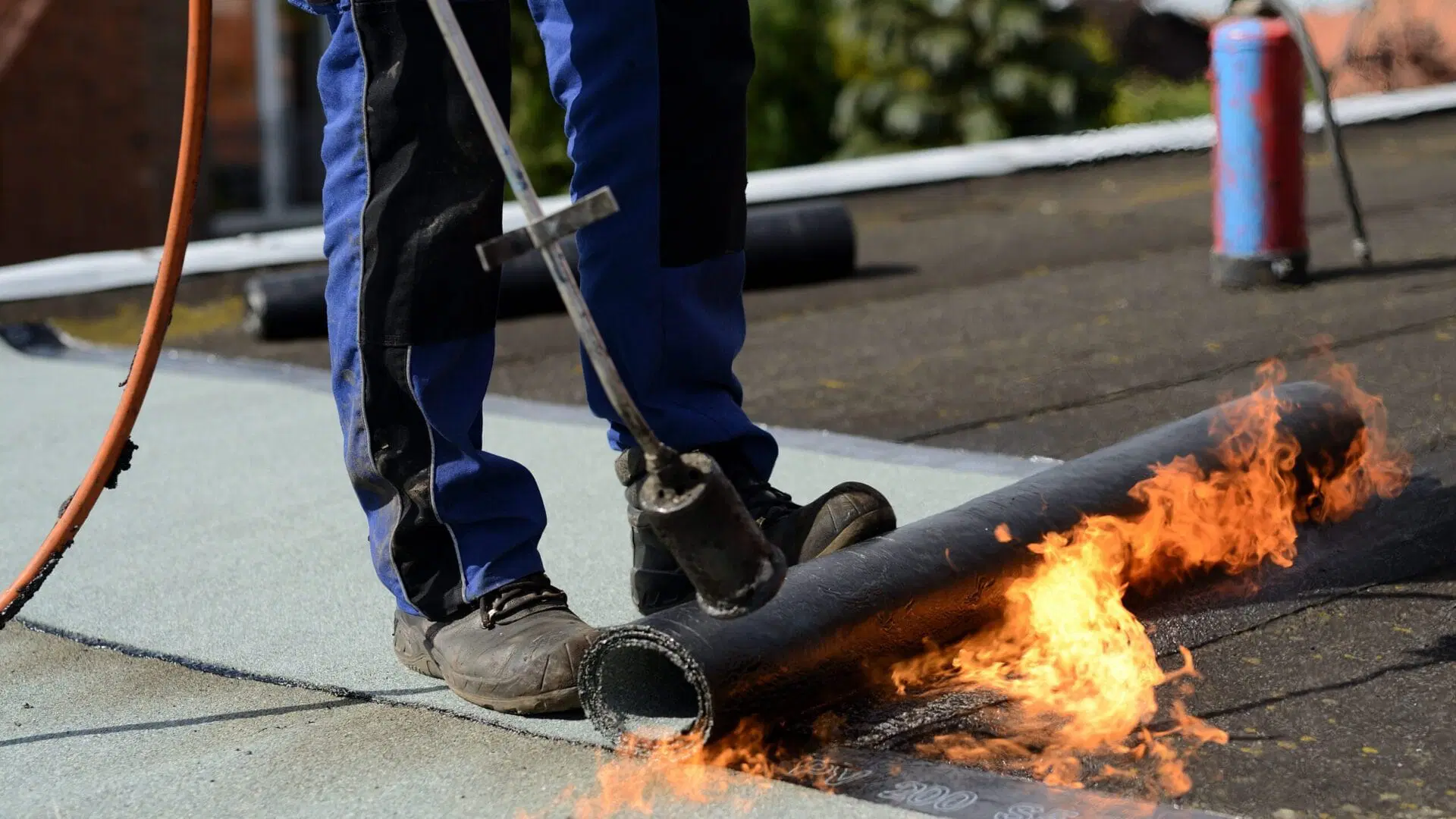
Modified bitumen remains the most appropriate system for Memphis commercial buildings with heavy mechanical traffic, high foot-traffic rooftops, or existing BUR assemblies where a compatible recover extends asset life at reasonable cost.
Modified bitumen roofing is the engineered successor to built-up roofing - asphalt modified with either SBS (styrene-butadiene-styrene) rubber for elasticity or APP (atactic polypropylene) plastic for UV resistance, reinforced with polyester or fiberglass mat, and applied in one or two plies over a prepared substrate. In Memphis, modified bitumen is most commonly encountered on buildings constructed in the 1980s and early 1990s that ran four-ply BUR systems and have been recovered once or twice with modified bitumen cap sheets over the original gravel surface.
The system's durability advantages are real for specific Memphis building types: warehouses and industrial buildings in the Frayser, Raleigh, and South Memphis industrial corridors that see heavy foot traffic from maintenance staff; buildings where the existing BUR or modified bitumen system is sound and a recover is more economical than full replacement; and historic commercial buildings in the South Main Arts District and Downtown warehouse district where the additional dead load of gravel-surfaced modified bitumen is structurally compatible with the original concrete deck.
SBS vs. APP - Which Modified Bitumen for Memphis Conditions
SBS-modified bitumen is the specification for most Memphis commercial new installation. SBS rubber modification gives the membrane elastomeric recovery - it stretches under load and returns to its original dimension. This is particularly relevant in Memphis because the Mississippi River alluvial subsoil drives seasonal building movement that produces parapet displacement, deck deflection, and expansion joint stress. An SBS membrane with proper reinforcement handles this movement without cracking at low temperatures. SBS systems are torch-applied or self-adhered; most commercial installation in Memphis is self-adhered on the base ply and torch-applied on the cap ply, a combination that delivers code-compliant fire resistance and manufacturer warranty eligibility.
APP-modified bitumen is the alternative for buildings where elevated UV resistance is the priority and elastomeric recovery is less critical - south-facing rooftop applications with high solar exposure, granule-surfaced cap-sheet systems where the aesthetics of a smooth cap are undesirable, and buildings in the commercial corridors east of Memphis where the mature tree canopy creates debris-accumulation conditions that a granule surface handles better than a smooth membrane. APP is processed into the bitumen differently than SBS and does not retain elastomeric properties at low temperatures - Memphis's occasional hard-freeze events (sub-20°F temperatures) are a design consideration for APP in an exposed application.
Gravel-surfaced vs. granule-surfaced vs. smooth cap: Gravel-surfaced cap sheet provides the best UV and mechanical protection but adds weight - a relevant consideration on older concrete decks in the Downtown warehouse district. Granule-surfaced cap sheet is the standard for most Memphis commercial modified bitumen work - provides UV protection, reduces surface temperature relative to a smooth dark cap, and does not add the dead load of gravel. Smooth cap with silicone or acrylic coating is the specification for modified bitumen recover applications where the building owner wants to restore reflectivity.
Hot-Work Permit Requirements and Memphis-Specific Considerations
Torch-applied modified bitumen requires a hot-work permit in all Memphis commercial applications. The Memphis Fire Department's hot-work permit process requires a permit for each project, a fire watch during all torch operations, and a one-hour post-operations fire watch after torch work concludes. On buildings with active fire-suppression systems - which includes most commercial buildings in Downtown Memphis, the Medical District, and the University of Memphis campus - hot-work protocols require notification to the building's fire-suppression monitoring service before and after torch operations.
St. Jude Children's Research Hospital campus facilities and the broader Medical District corridor on Madison Avenue require pre-work coordination that goes beyond the standard Memphis hot-work permit. Infection-control requirements on occupied research and clinical buildings restrict the timing and location of torch operations - we coordinate directly with the facility team before any modified bitumen torch work on these buildings. The same applies to University of Memphis campus buildings, where hot-work operations near occupied academic or administrative spaces require advance scheduling with the campus facilities office.
Self-adhered modified bitumen: For buildings where torch work is not feasible - active fire-suppression systems without isolation capability, facilities with flammable material storage nearby, or buildings where the facility management team has a no-hot-work policy - we specify self-adhered base ply with a compatible cold-adhesive or torch cap ply in areas where torch work is permissible. Self-adhered systems are also the default for modified bitumen recover applications where the existing membrane surface temperature makes torch application impractical.
Modified bitumen project for your Memphis commercial building?
We will assess the existing roof condition, pull cores, and deliver a written scope - recover or replacement, with the SBS or APP specification that fits your building use and capital horizon.