Parapet base flashings on Memphis commercial buildings fail faster than in most American markets - the silty clay alluvial subsoil under Memphis moves seasonally, and that movement tears standard flashing terminations away from the wall. We repair it properly.
If you run inspection routes across Memphis commercial buildings with any regularity, you develop a reliable prediction: any flat-roofed building built before 2005 with masonry parapet walls will show base flashing separation somewhere on the perimeter. It is not a coincidence and it is not deferred maintenance - it is a direct consequence of the soil condition under Memphis.
The silty clay loam deposited by the Mississippi River beneath most of the Memphis metro expands when wet and contracts when dry. Over a typical Memphis year - wet springs, drier summers - the buildings on this substrate move laterally at the parapet walls by fractions of an inch to a full inch, cyclically. Pre-2005 parapet flashing details bonded the base flashing membrane directly to the masonry wall face. When the wall moves and the roof deck does not, the bond fails at the base flashing termination. Water enters at that separation and begins saturating the insulation board adjacent to the parapet.
Parapet Components and Common Memphis Failure Modes
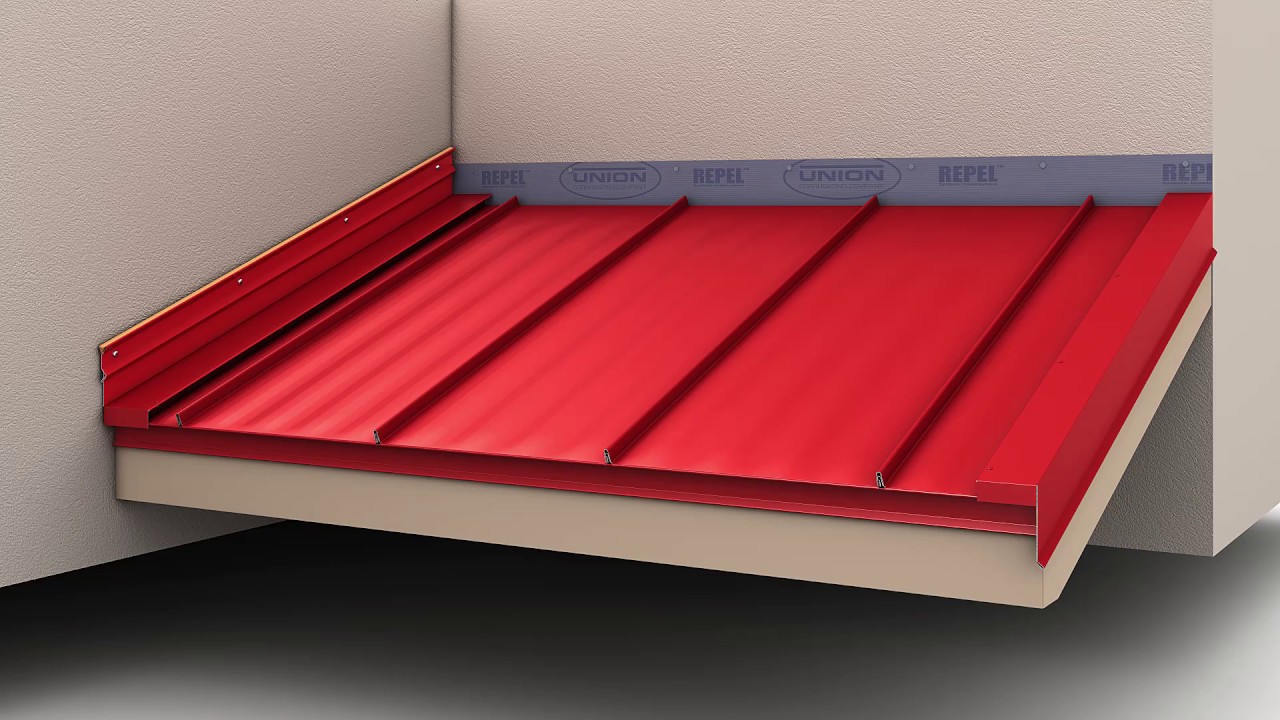
Base flashing: The membrane component that runs from the roof field up the vertical face of the parapet wall - typically 8-12 inches of vertical coverage terminated at the top with a counter-flashing. Base flashing failure in Memphis is almost always at the bottom termination, where the base flashing bonds to the roof field. When the parapet wall moves relative to the deck, this bond point is the stress concentration. Repair scope: full removal of the failed base flashing section, installation of new base flashing bonded to the roof field membrane, terminated at the top with a reglet counter-flashing set into a sawn saw-cut in the masonry.
Counter-flashing: The metal flashing component that covers the top termination of the base flashing and is embedded in the masonry wall. Counter-flashings on Memphis commercial buildings fail in two ways: the sealant in the masonry reglet dries and cracks, allowing water to enter behind the counter-flashing and behind the base flashing; or the counter-flashing is not embedded in the masonry at all - it is face-nailed to the wall face, which produces an unreliable seal that fails within five years. Repair scope: remove and reset face-nailed counter-flashings into proper reglet locations, replace degraded sealant in existing reglet-mounted flashings.
Parapet coping: The cap element across the top of the parapet wall - typically precast concrete, metal, or cast-in-place at older Memphis buildings. Coping failures allow water entry at the top of the parapet that runs down behind the base flashing, saturating the insulation from the top rather than the bottom. The most common coping failure on Memphis buildings is open bed joint mortar at precast coping units - mortar dries, cracks, and spalls with the seasonal temperature cycling. Repair scope: repoint open bed joints with elastomeric sealant or mortar depending on joint width, replace cracked precast units, ensure positive drainage slope away from the roof side of the coping.
Repair Details That Accommodate Memphis Soil Movement
Slip-sheet base flashing: The modern standard for parapet base flashing on Memphis buildings. A separation layer - typically a polyethylene slip sheet - is installed between the wall face and the base flashing membrane. This allows the wall to move relative to the base flashing without tearing the bond. The slip sheet extends from the roof deck up to the counter-flashing reglet. The base flashing adheres to the roof field and is mechanically terminated at the top with the counter-flashing - it never bonds directly to the wall face.
Flexible sealant terminations: Every counter-flashing reglet termination uses a low-modulus polyurethane or silicone sealant - not hardening epoxy or rigid caulk - so the seal can flex through the seasonal movement cycle without cracking. Rigid sealants fail at the sealant-to-metal interface within two to three years on Memphis parapet walls; flexible sealants properly applied hold through a decade of movement cycling.
Two-ply base flashing at critical transitions: At inside and outside parapet corners - the highest stress concentration points on any parapet flashing system - we run a two-ply base flashing detail: a stripping ply bonded to the field membrane at the transition, then the full base flashing over it. Corner failures are the second most common base flashing failure mode after straight-run separation.
When to Prioritize Parapet Repair vs. Full Replacement
Parapet flashing repair makes sense when the roof field membrane is in serviceable condition - dry insulation on core pull, no systemic seam failures - and the parapet failure is limited to specific runs or corners. A full perimeter parapet flashing replacement on a 30,000 sq ft building in serviceable condition can extend the roof system life by a decade at a fraction of full replacement cost.
When parapet failures are accompanied by saturated insulation adjacent to the parapet wall across 25% or more of the perimeter - a pattern we see frequently on Memphis buildings where the base flashing has been allowing slow water entry for years - the scope shifts toward full replacement. Saturated insulation against the parapet is difficult to address with targeted removal in a recover; the moisture has often migrated well into the field insulation. In that case, replacement with a full perimeter parapet detail replacement is the right scope.
Parapet wall or base flashing failure on a Memphis commercial building?
We diagnose the failure mode, specify a repair detail that accommodates Memphis soil movement, and close out with documented before-and-after evidence.